

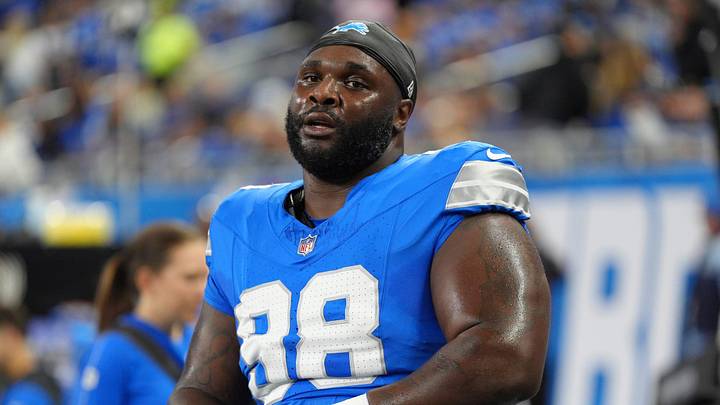
Heading into the 2026 NFL Draft, former Detroit Lions defensive tackle DJ Reader's next stop became abundantly clear: the New York Giants.
Reader eventually did agree to a deal with the Giants on May 5th, effectively replacing Dexter Lawrence, who was traded to the Cincinnati Bengals.
With a sizable two-year deal, worth at least $12.5 million, the Lions were unlikely to pay that cost, given their cap constraints. However, the timing of Reader's signing is still likely to cost the Lions something valuable.
Jeremy Reisman of Pride of Detroit points out an interesting free agency quirk, being that players who sign with a new team after the draft do not yield a compensatory pick for their former team.
Reisman suggests the intention of this rule was "perhaps encouraging teams to sign veterans who still hoped to continue their careers," but instead, teams have been using it as a loophole to avoid worsening or losing their own compensatory picks.
Had Reader signed with the Giants back when he visited the team in mid-April and when it started to be widely reported, or speculated, that he would eventually sign with them, the Lions would've received a late-round compensatory pick.
Reisman explains the potential motive for why the Giants might want to do this:
"As it stands, the Giants are projected to earn a 2027 fourth-round compensatory pick after Wan’Dale Robinson signed a four-year, $70 million contract with the Titans. If Reader’s reported deal were to count in the formula, it would likely downgrade that pick to a later round. There’s a clear motivation for the Giants to wait."
It's always possible that this is a coincidence, as Reisman notes that the Giants could've simply been waiting to see how the draft turned out, or that Reader wanted to wait for whatever reason. Reader did visit the Baltimore Ravens, and his eventual contract numbers would support the argument that there was some competition for his services.
There may be some hope that this could get rectified, albeit an extremely slim one. Reisman points to a post on X from Jason Fitzgerald of Over the Cap, who questions the leak of Reader's intended signing from the NY Post's Paul Schwartz, and covered by GMEN HQ's Doug Rush, whose post Fitzgerald quoted.
Fitzgerald wonders if this leak, especially the portion from Schwartz reporting that the signing may be delayed as a means to "delay comp consequences," could be a "mistake." Fitzgerald adds that, "Sometimes if the league feels a deal is agreed to before the cutoff date but the sides delay to game the system they will consider it a UFA signing."
Where does this leave the Lions and the 2027 Draft?
If Fitzgerald's suggestion comes to pass, the Lions would receive the late-round, likely sixth-round, compensatory pick with Reader's signing.
This would give the Lions a third sixth-round compensatory pick. Over the Cap had initially projected one of those picks, for Al-Quadin Muhammad's departure, as a seventh-rounder. The original projections had offensive tackle Larry Borom as a sixth-round value, which meant his signing cancelled out the sixth-round value of DT Roy Lopez's departure.
But after Borom's comp projection was updated to a seventh-rounder, his signing cancelled out Muhammad's departure, resulting in the Lions projected to receive a second sixth-rounder instead of a seventh.
READ MORE: Lions drop in ESPN's first power rankings after free agency and the draft
Missing out on an extra sixth-rounder hurts. That extra pick could've been packaged in for a trade-up. It could've been used to acquire a veteran at the trade deadline. The Lions could've also found a diamond in the rough or a solid enough starter with that pick. Their current starting left guard, Christian Mahogany, was a sixth-round pick in 2024, for example.
The odds that the NFL will step in and retroactively count the Reader signing as a pre-draft one and allow the Lions to pick up an extra pick are low. And, to be fair, the Lions have likely taken advantage of this loophole in the past, too. Yet, never as suspicious and as visible as it seems to be right now with the Giants and Reader.
What Reader's signing does is highlight one of the many ways teams can manipulate the free agency rules to their benefit at the expense of another team. Maybe the Giants didn't intentionally do so, but it illustrates how a team could. For that reason, the NFL should explore a way to tweak its compensatory rules and close this loophole.
 Add us as a preferred source on Google