

Earlier this offseason, the Detroit Lions parted ways with David Montgomery. Montgomery had been the Knuckles of the self-coined Sonic and Knuckles, running tandem in Detroit because of his physical running style. Jahmyr Gibbs, who often displays his blazing speed, of course, is the Sonic.
It was rumored that Montgomery was hoping for a greater workload in this running back timeshare, but it became very difficult to remove a player of Gibbs' caliber from the field. Gibbs isn’t just a speedster; he has the ability to run between the tackles and proved to be a dynamic receiving weapon, plus every time he has the ball in his hands, he’s a home run threat.
The truth is in the numbers. During the 2024 season, Gibbs racked up an impressive 1,412 rushing yards and led the league with 16 rushing touchdowns on 250 attempts. He also contributed 52 receptions on 63 targets for 517 yards and four touchdowns through the air.
Last season, Gibbs backed up that production with 1,223 rushing yards and added 77 receptions for 616 yards, finishing with 18 total touchdowns. In 2024, Montgomery scored 12 rushing touchdowns and totaled 775 yards on 185 carries. He'd follow that up with 716 yards and eight scores on the ground in 2025. He was also a viable receiver, catching 60 balls for 533 yards over those two seasons.
With Montgomery out of town and now eyeing the lead back role in Houston, Detroit Lions general manager Brad Holmes brought in veteran Isiah Pacheco to be his replacement. Pacheco, 27, an unrestricted free agent, signed a one-year, fully guaranteed, team-friendly deal with the Lions this past March worth $1.81 million.
Pacheco and his unique stomping style will look to be that punishing runner who can wear down defenses with his four yards and a cloud-of-dust approach.
Pacheco had two really good years with the Kansas City Chiefs to begin his career, rushing for 830 and 935 yards, respectively, totaling 12 rushing touchdowns over those two seasons. However, he’s never been a viable receiving threat; his best receiving season came in year two, when he caught 44 balls for 244 yards and a pair of scores.
Over his last two seasons with the Chiefs, Pacheco’s numbers dipped considerably, likely prompting the team to move on and secure Super Bowl MVP Kenneth Walker in free agency. Injuries limited Pacheco to just 772 rushing yards combined in 2024 and 2025, but for Detroit, this is a low-risk, mid-level reward move.
Should Gibbs miss time, Pacheco can fill in over the short term. Still, the Lions would be wise to consider strengthening the position through the draft to ensure they’re protected if their franchise running back suffers a multi-week injury. While NFL teams are starting to invest more in running backs, there are still plenty of impactful options to be found in the middle to late rounds of the draft.
Running backs the Detroit Lions need to target in the NFL Draft
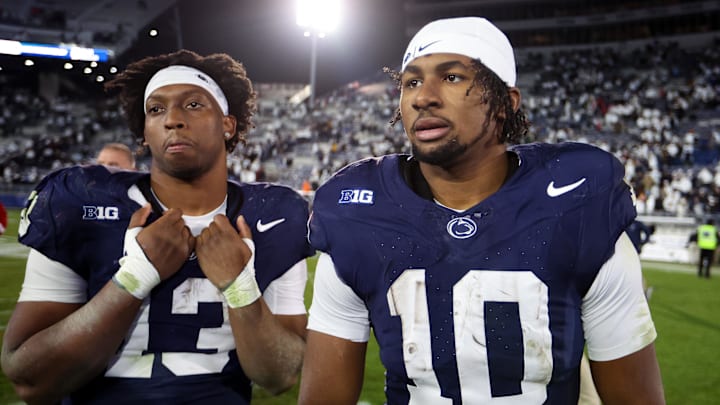
Two names that stand out are Kaytron Allen and Nick Singleton from Penn State. Allen, the bruiser of the Nittany Lions’ backfield, would be a perfect complement to Gibbs.
In 2025, Allen averaged 6.2 yards per carry, finishing with 1,303 rushing yards and 15 touchdowns, but he added just 68 receiving yards on 18 catches.
Mock drafts project Allen to be in the RB7–RB10 range, and likely to be available between picks No. 110–170. Conveniently, the Lions hold their own No. 118 pick, plus pick 128 from the Texans (via the Montgomery trade) in the fourth round, maybe putting Allen well within their reach.
Singleton, Penn State’s “sonic,” is the more dynamic of the two, but his 24 receptions for 219 yards and 123 carries for 549 rushing yards and 13 touchdowns last season don't exactly justify that notion, mostly because of how Penn State prefers to play.
The Nittany Lions leaned heavily on ground-and-pound, but Singleton’s speed and receiving skills give him a higher NFL ceiling, according to most mock draft analysts.
READ MORE: Evaluating the state of the Detroit Lions’ cornerback room
He’s also projected as an RB6–RB10, with most mock drafts slotting him between picks No. 90 and 120. Despite being less productive than Allen in college, Singleton’s skill set seems to be generating slightly more interest among NFL evaluators than Allen's.
In my opinion, the dream scenario for the Detroit Lions would be to land Mike Washington Jr. from Arkansas.
Washington Jr. is the perfect blend of power and speed, standing 6-foot-1 and weighing around 225 pounds, yet clocking an eye-popping 4.33 in the 40-yard dash. Last season, he averaged 6.4 yards per carry, amassing 1,070 rushing yards and eight touchdowns, along with 28 receptions for 228 yards and a touchdown. Still, Washington Jr. comes with red flags.
He had 10 fumbles on 587 career carries over his college career and is an unproven pass protector, something teams covet particularly on third downs. Although blocking woes are common for young backs at the NFL level, it’s a concern if it is a struggle throughout college.
Washington Jr. is widely regarded as a top-five talent at his position, though, like anything else, opinions differ. ESPN’s Aaron Schatz lists him fifth, but the brand as a whole collectively ranks him third, CBS puts him seventh (No. 182 overall), and Pro Football Focus rates him third at the position and 71st overall.
If he happens to slide to the fourth round, Detroit could have a legitimate shot at a potential future star in waiting.
Detroit’s backfield is strong with Gibbs at the helm and Pacheco providing insurance, but it could be better. The 2026 NFL Draft presents a real opportunity for the Lions to add depth and versatility with mid-round selections like Allen or Singleton, or perhaps to swing for the fences with Washington Jr.
The Lions can assure their running game remains a strength after rebuilding their offensive line by adding another cheap rushing threat midway through the draft.
 Add us as a preferred source on Google