

Wednesday gave Detroit Lions fans the news they've been eagerly waiting for. No, not Trey Hendrickson signing with the Lions -- he instead went to Baltimore after the Maxx Crosby trade fell through.
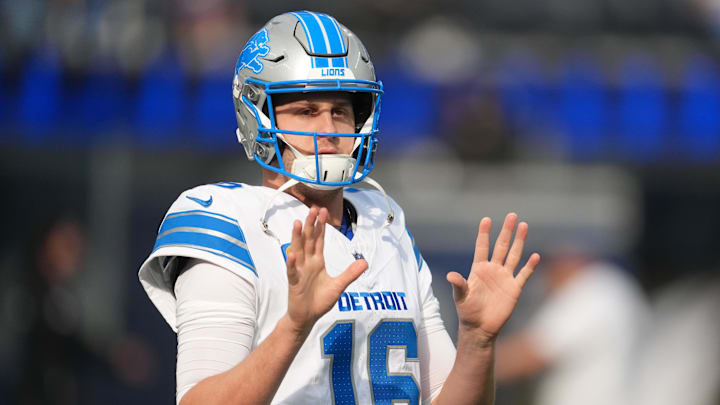
Instead, the Lions have restructured quarterback Jared Goff's contract, per NFL Network's Tom Pelissero. The move frees up $32 million for the Lions entering the heart of the free agency season.
$32 million is a lot of money that could be spent on positions of need. Not to mention the Crosby dream is alive once again. Surely, the Lions will use those new funds to aggressively tackle needs on the defense, right?
Not so fast!
While there were debates aplenty about whether a restructure would happen, and what it would mean if it didn't, the Lions did have to do something to ensure they're cap compliant by the NFL's 4:00 P.M. (EST) deadline on Wednesday. A restructure of some sort, whether it was Goff, tackle Penei Sewell, or wide receiver Amon-Ra St. Brown, was expected.
Of course, this isn't free money. A restructure converts a part of the contract to a signing bonus, allowing the team to spread out the cap hit beyond this season.
Per Over the Cap, Goff's cap hit increases by $8 million in 2027 and 2028. 2029 is now a void year, in which Goff will have a $16 million cap hit, even if he departs the team as a free agent.
Where will that $32 million go?
What's noteworthy is how much the Lions freed up. $32 million is big, but it's less than the roughly $43 million in space they could've added with a Goff restructure. That alone should be a hint that general manager Brad Holmes and the Lions are being cautious with the future salary cap.
One reason why the Lions may be cautious is the impending contract extensions, such as for running back Jahmyr Gibbs and linebacker Jack Campbell. Those extensions will likely include signing bonuses that would affect this year's cap before the full contract kicks in. But wait too long to extend them, and their value skyrockets, as we've seen with WRs.
There's also the matter of the moves they've already made, and the cap hits from players leaving. For example, RB David Montgomery may no longer be a Lion, but they're still on the hook for some of Montgomery's contract. Likewise, the Lions' big signing so far, center Cade Mays, has an AAV of $8.33 in his deal.
READ MORE: Lions Free-Agency Tracker 2026: Signings, departures, cap space analysis, and more
But that's not all. The Lions still have to pay their rookies. Spotrac estimates the Lions 2026 draft class will cost just under $6.5 million, accounting for the "Top-51" rule, where only the 51 highest salaries count against the cap.
That's all to say that those smaller numbers add up, especially for a team that was initially over the cap. The Lions will still have wiggle room to sign players, even notable ones like Cam Jordan. However, by not maximizing the Goff restructure right now, the Lions are signalling that they're sticking to their guns and won't be making a big, splashy move.
Then again, free agency is unpredictable, and this could go down as a Freezing Cold Take. For now, it's best to assume the Lions will continue to make smaller, under-the-radar signings rather than pursuing big fish.
 Add us as a preferred source on Google